
Nectar
Highlights
Industry challenge
Honey bees are critical to the global food supply, pollinating nearly a third of crops worldwide, yet colonies face rising mortality due to parasites, pesticides, and climate pressures.
Innovative solution
Nectar’s purpose-built sensors and analytics deliver real-time insights into hive health, giving beekeepers the data needed to prevent swarming, reduce colony loss, and optimize honey production.
Powered by Soracom
Global multicarrier cellular IoT ensures reliable data collection across thousands of square miles, even as hives move seasonally, with one SIM supporting expansion into new regions.
A local team with global impact
Nectar was founded in 2015 by Montréal-based designer and beekeeper Marc-André Roberge. What began as a personal project to support a new generation of urban beekeepers quickly revealed a much larger opportunity. Roberge recognized that the same connected technology that could help hobbyists manage a few hives in the city might also transform the way commercial beekeepers operate across thousands of hives.
Since then, the company has grown into an international player in precision beekeeping. Today, Nectar connects more than 1,500 hives across the US and Canada, equipping beekeepers with purpose-built sensors and analytics tools that dramatically improve visibility into hive health. With over 15 million bees now connected, the company has already demonstrated the ability to reduce operational costs while improving productivity and survival rates.
As demand for pollination continues to increase worldwide, Nectar’s mission has expanded from its local roots to a global vision. By combining field experience with innovative technology, Nectar is positioning itself as a key contributor to food security and agricultural resilience around the world.

Challenge: A crucial link in the global food supply chain
Honey bees pollinate nearly a third of the crops humans rely on, from fruits and nuts to vegetables and grains. In economic terms, this pollination represents more than $200 billion USD in value every year. Beyond numbers, bees make possible the growth of nutrient-dense foods that are essential to healthy diets around the world.
Yet for decades, bee populations have been in sharp decline. In North America and Europe, colonies have been dying in large numbers for more than 20 years, with annual losses still estimated at 30% or more. The causes are complex and varied, from pesticides and parasites to climate stress and changing land use, but the result is the same: fewer bees, weaker hives, and reduced pollination capacity.
For commercial beekeepers, this creates both a challenge and an opportunity. Protecting colonies requires early detection of stressors and timely intervention, but traditional monitoring methods rely heavily on manual inspection. This is time-consuming, labor-intensive, and often comes too late to prevent damage. The industry needs new ways to “listen” to hives in real time and respond before small issues become catastrophic losses.
Solution: A new level of communication between beekeeper and hive
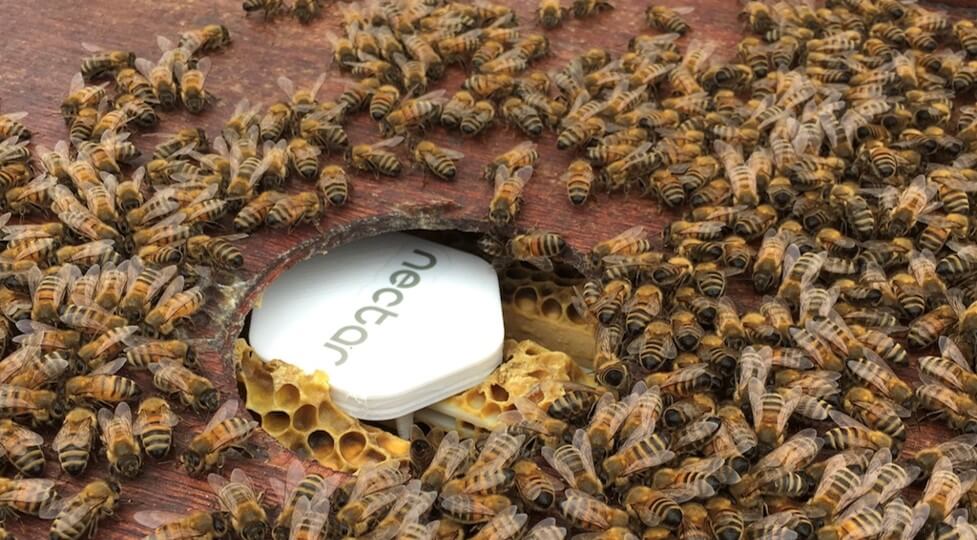
Nectar developed its wireless “Beecons” to provide exactly this capability. Installed directly in the hive, these sensors track conditions such as temperature, humidity, movement, and even sound. Data from multiple hives is then collected by solar-powered BeeHubs and transmitted to the cloud, where Nectar’s analytics platform interprets the results.
This constant flow of information gives beekeepers a clear picture of hive activity and health. They can monitor honey production, identify when a queen goes missing, predict swarming behavior, and detect environmental changes that could threaten colony survival. Instead of reacting to problems after they occur, beekeepers gain the ability to prevent them.
More advanced applications extend these benefits even further. By combining real-time sensor data with algorithms developed by experienced beekeepers, Nectar helps users make informed decisions about hive management, seasonal transitions, and crop pollination timing. The result is not only healthier bees but also better yields for growers who depend on them.
Why Soracom: Global cellular IoT made simple
Beekeeping is not confined to small, fixed locations. Commercial operations often manage thousands of hives spread across vast rural areas, sometimes equivalent in size to a small country. To ensure colonies don’t compete with each other, hives are often distributed across wide territories, and during pollination season they may be moved hundreds of miles by truck.
These conditions make traditional connectivity options impractical. Wired infrastructure is rarely available in rural fields, and Wi-Fi coverage is unreliable and difficult to manage across such large areas. Cellular data offers the flexibility and range that beekeepers need, ensuring that hive data flows consistently to the cloud even as hives move from place to place.
With Soracom, Nectar gains access to a multicarrier SIM that automatically connects to the strongest available signal, no matter where a hive is located. And because Soracom’s global SIM works seamlessly across borders, Nectar does not need to negotiate separate contracts for each new market. This combination of simplicity, reliability, and scalability makes it possible for Nectar to focus on protecting bees instead of managing connectivity.
Future Plans: Toward smarter, more sustainable beekeeping
The future of agriculture depends heavily on pollination, and the future of pollination depends on healthy bees. As growers demand more reliable pollination services, Nectar is working to expand its hardware and software offerings to meet a wide range of beekeeping needs. Some beekeepers focus on honey production, others on pollination services, and still others on breeding strong colonies. Each of these goals requires different data, and Nectar is building the flexibility to serve them all.
Future hardware releases will give users even greater visibility into hive activity and health, with options to tailor insights to specific goals. This will help beekeepers make more precise management decisions, reduce costs, and protect their investment in bee populations.
Beyond serving individual operations, Nectar also sees an opportunity to strengthen collaboration between beekeepers and growers. By using sensor data as a trusted source of verification, Nectar can help growers confirm pollination quality and optimize crop yields, creating a shared foundation of trust that benefits both sides. Ultimately, this aligns with the company’s mission to create healthier bees, healthier crops, and a healthier planet.
Nectar – Company Overview
Nectar was founded on the premise that better technology could help solve one of the big environmental issues of our time: supporting the crucial role that honey bees play in the food system. We believe that to reverse the accelerating cycle of downward pressure on beekeepers, beekeepers must undergo a digital transformation, augmenting their intelligence with the power of data.




Champion in IoT
Connectivity Management
Soracom Named as a Champion for IoT Connectivity Management in 2023 Kaleido Intelligence Connectivity Vendor Hub